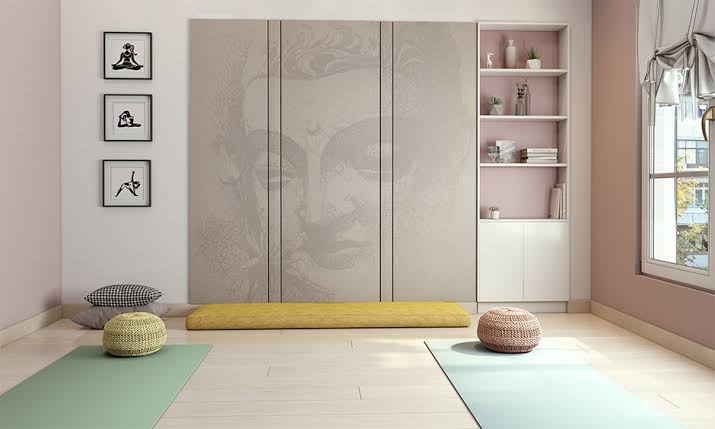
Are you worried that you can't do daily yoga practice, because you don't have a sprawling studio with hardwood floors?
Then stop worrying and start rejoicing! Because we are here to tell you that it's totally possible to have rewarding practice at home.
There are a lot of dedicated home practitioners who routinely roll out their mats in their compact bedrooms, busy living rooms, or studio apartments, and enjoy the benefits of yoga and achieve their desired body.
You must know that establishing a dedicated practice space relies less on perfect aesthetics and more on creating a reliable psychological trigger for your mind: It is time to slow down, breathe, and focus.
Once you have the mindset, the next thing which is needed is making the best of the space you have. You must know if you are practicing at home in a poorly arranged environment, it won't be just distracting?it can compromise your movement mechanics and also cause some unwanted injuries.
4 Steps to Build a Safe Home Yoga Sanctuary
1. Establish Your "Fall Zone" (Safety Radius)
The Environmental Hazard: If you put your yoga mat near sharp corners of furniture, unstable decor or low hanging ceiling fans or other stuff.
The Physical Impact: Because of this you will experience a lot of restrictions in your range of motion, you will be forced to do awkward postural adjustments, and which increases the risk of collisions.
The Practical Fix: To fix this issue, you can start with doing a 360-degree sweep before unrolling your mat. So just stand in the center and extend your arms horizontally to its full range, and rotate in a full circle. Next thing you should do is reach straight overhead. Make sure you are in a position where you can maintain at least one foot of clear space around all edges of your mat.
2. Secure a Stable, High-Grip Foundation
The Environmental Hazard: When you practice yoga by using thin, low-density foam mats or when you are practicing directly on slippery rugs and carpeted surfaces.
The Physical Impact: A slipping mat will make your practice really uncomfortable, it will create joint instability in the wrists and ankles, which will lead to sudden muscle micro-tears while transitioning between dynamic standing poses.
The Practical Fix: We recommend that you put your money in a dense, non-slip rubber mat (4mm to 6mm thick). If you are practicing on carpet, you must place a rigid under-mat board beneath your setup so that it helps you in maintaining a flat surface and prevent excessive ankle inversion.
3. Eliminate Visual Clutter to Lower Cortisol
The Environmental Hazard: When you are facing stuff like unmade beds, piles of laundry, or work equipment which keep distracting you and keep your mind thinking about doing all unfinished stuff while you are attempting to quiet your mind.
The Physical Impact: When there is a lot of Visual clutter around you, it keeps your sympathetic nervous system on high alert, and also boosts cortisol levels and significantly undermines stress reduction, which restricts you from achieving relaxation during practice.
The Practical Fix: Make sure that your mat is facing towards a blank wall, closed door, or any clean corner. If space is tight, use a folding screen or tall indoor plant to block work items from your line of sight, that will keep your mind focused on the practice.
4. Optimize Lighting for Parasympathetic Activation
The Environmental Hazard: When you are practicing directly under harsh fluorescent or cool-toned overhead lighting, especially during reclined poses like Savasana.
The Physical Impact: If you do that it will cause strain to your eyes and signal alertness, which prevents your nervous system from relaxing properly for effective practice.
The Practical Fix: It is always wise to turn off overhead fixtures in favor of warm floor-level lamps or diffused natural light from sheer window curtains.
Home Studio Safety Checklist:
Clearance: Can you stretch your limbs fully in all directions without any contact with any nearby object?
Mat Stability: Is your mat firmly placed without you feeling any sliding or slipping when pressure is applied?
Focal View: Do you have a clean view in front, which is free from all distractions?
Air Circulation: Is the room where you will practice having proper ventilation?
Device Control: Are you keeping your phone placed face-down on "Do Not Disturb"?
Structural Safety & Medical Caution:
Having a sense of environmental safety is extremely important when it comes to keeping yourself safe from a potential injury.
We recommend that you must avoid certain poses which can be risky. For example, don't attempt advanced inversions (such as headstands or handstands) if you have furniture, glass windows, or wall hangings etc nearby. If you experience vertigo, balance impairments, or dizziness, keep a sturdy chair nearby for support.
Also most importantly, consult a physician before practicing if you have pre-existing joint or vestibular conditions. Keep in mind, safety, health and wellness is always the number one priority!