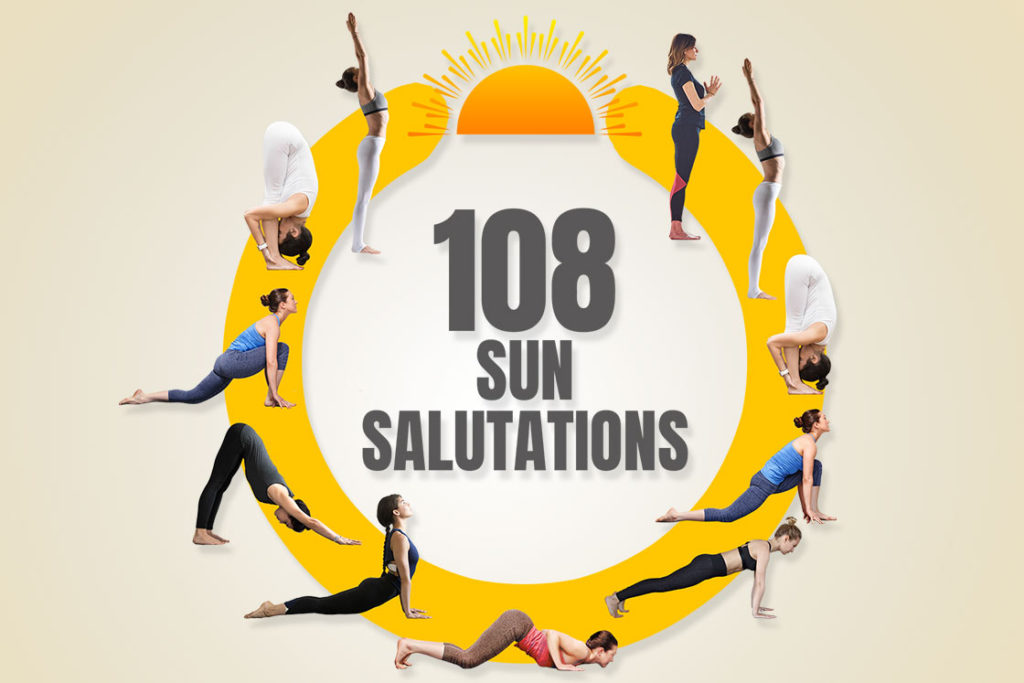
The most famous sequence in yoga is Surya Namaskar (Sun Salutations), every yoga enthusiast knows that there are countless benefits of this wonderful routine. So like everyone who hears it and is looking for a yoga routine, you look for all the 12 poses and want to give it a try.
You roll your mat, stand on it and sweep your arms above your head, then bend forward into a deep bow and after that raise your head to go to the next pose. But the moment you lift your head, you feel the room spinning. You feel that there is a sudden wave of lightheadedness, your vision also feels a bit dim and you have to pause to catch your breath.
Mild dizziness during Sun Salutations is a common thing which frustrates both beginners and experienced practitioners. You might confuse this as the lack of stamina, but this sudden spinning sensation is a physiological reaction which is triggered by orthostatic cardiovascular shifts and improper mechanics of breathing.
When you transition quickly from inversion (folding down) and upright extension (lifting up), gravity forces blood to pool in your lower extremities, which causes a momentary lack of oxygen in your brain. If you combine these rapid elevation changes with forceful chest breathing, your body will experience a protective vasovagal reflex that drops your blood pressure further.
Note: If dizziness is way too much it's not subsidising quickly, call the healthcare services, because it could be a neurological issue.
3 Biomechanical Fixes for Safe, Steady Transitions:
1. Rapid Vertical Rises vs. Hinged Inhalation Mechanics
The Habitual Error: Jerking your head and torso upright very fast from a deep Forward Fold (Uttanasana) to Standing Mountain Pose (Tadasana).
The Mechanical Strain: By doing sudden rapid movements with your through a 180-degree vertical plane, you force your cardiovascular system to function against gravity immediately. This will also cause a sudden delay in blood flow to the brain, which further triggers orthostatic hypotension and immediate lightheadedness.
The Structural Reset (The Halfway Lift Buffer): Never rise in a single, fast motion. Pause at Halfway Lift (Ardha Uttanasana) with a flat back while coordinating this movement with one. full breath. This intermediate horizontal plane allows your baroreceptors (blood pressure sensors in your carotid arteries) to adjust to the elevation change before you sweep all the way up to standing.
2. Shallow Chest Hyperventilation vs. Diaphragmatic Nasal Synchronization
The Habitual Error:Taking short, and quick breaths through your mouth to keep up with a fast-paced vinyasa flow.
The Mechanical Strain: When you do fast mouth breathing, it blows off carbon dioxide way too fast, which leads to hypocapnia. These low carbon dioxide levels will cause cerebral blood vessels to constrict, and also reduce oxygen delivery to the brain and amplifying dizziness.
The Structural Reset (Ujjayi Breath Anchor): Close your mouth and switch exclusively to slow, regulated nasal breathing with a soft throat constriction (Ujjayi breath). Match every movement to an unforced breath: inhale as you open the chest and extend upward; exhale as you fold down and compress inward. Keeping carbon dioxide levels stable prevents vasoconstriction.
3. Neck Hyperextension vs. Cervical Spine Neutrality
The Habitual Error: Yanking your head back and trying to look at the ceiling during Cobra Pose (Bhujangasana) or Upward Salute (Urdhva Hastasana).
The Mechanical Strain: When you hyperextend your cervical spine, it will cause compression in the suboccipital region, which pinches the vertebral arteries and also reduces blood flow to the brain's balance center (the vestibular system).
The Structural Reset (Gaze Control / Drishti): Keep the back of your neck fully extended. Instead of throwing your head back to look straight up to the ceiling, raise your gaze gently with your eyes while making sure that you keep your chin slightly tucked. When you align your neck with your upper spine it preserves clear arterial blood flow.
Sun Salutation Flow Safety Checklist:
Paced Elevation: Are you taking momentary pauses in a flat-back position before you stand up fully?
Nasal Control: Is your breath moving from your nose specifically, without any gasping for air through your mouth?
Cervical Alignment: Are you keeping the back of your neck long and uncompressed while doing the backbends?
Soft Knees: Are keeping your knees slightly bent when folding and rising so that you prevent blood pooling in the hamstrings?
Medical Caution:
If you are only experiencing a little bit of discomfort like lightheadedness which goes away after sometime, this is not a big issue at all. It can be totally fixed by breathing the right way and moving in coordination with the breath in a gentle manner. But if you feel other discomforts which are more severe like sudden fainting (syncope), chest pain, severe vertigo, or numbness in your arms during your practice, you must discontinue and sit down comfortably.
If those issues stay the way they are or get worse, call the healthcare service immediately and get a thorough check of your whole body, it's possible that you might have some underlying issues like anemia, inner ear vestibular disorders, structural heart issues, or severe dehydration. And if you have spine or joint related issues talk with your doctor or physical therapist before attempting Surya Namaskara.