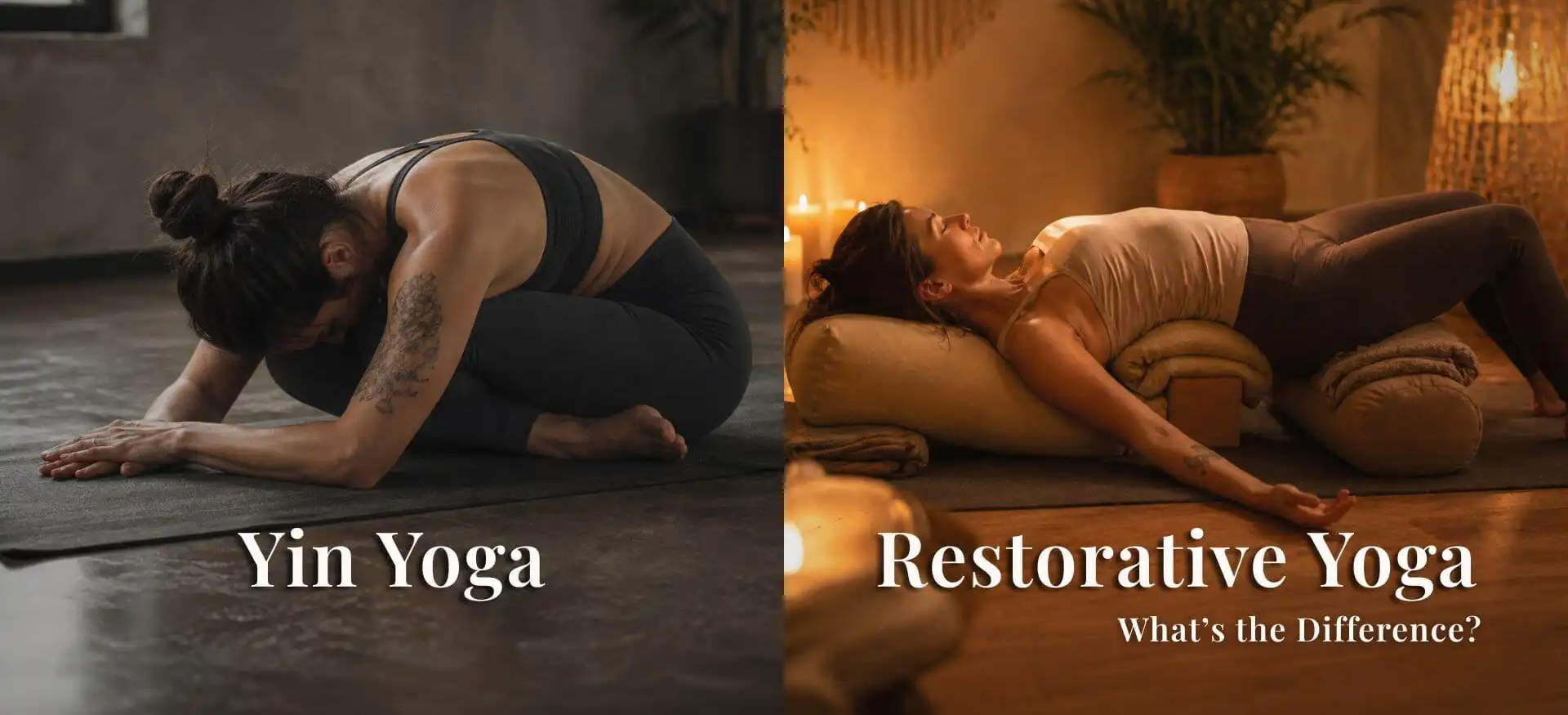
Many people who want to start yoga want to do it because they feel exhausted, tight or overwhelmed and their goal is to unwind. You might also be one of them and think about doing a routine, a flow which is slow and floor based.
You look for it online and find something called yin yoga. You find a routine in this segment; you roll out your mat, dim the lights, and prepare to hold postures on the ground for several minutes at a time. But might not get the needed benefits of your routine because many many practitioners confuse Yin Yoga and Restorative Yoga, and treat them as interchangeable terms for "gentle stretching."
While both of these styles are practices low to the ground and involve holding long poses, they target entirely different biological tissues and use principles of body mechanics which are in constant with each other.
If you practice Yin yoga when the actual need for your body is Restorative yoga?or vice versa?can cause damage like joint strain or leave you feeling frustrated with no benefits at all.
When we understand the mechanics of plastic deformation (which is targeted by yin yoga) versus neuromuscular relaxation ( where restorative yoga is useful), it allows you to select the exact stimulus which your body needs at the moment.
The Biomechanical Difference: Stressing Tissue vs. Supporting Tissue:
Yin Yoga and Restorative Yoga operate on completely different physiological pathways:
1. Yin Yoga and Plastic Deformation of Connective Tissue
Yin Yoga targets dense connective tissues?including ligaments, joint capsules, and deep fascial networks. Tissues rich in collagen respond to cold, passive, low-load mechanical stress applied steadily over 3 to 5 minutes. This kind of practice which is slow, and where uninterrupted tension is applied induces plastic deformation, safely lengthening the stiff connective matrix around your joints to expand your structural range of motion and helps you in rehydration deep tissue layers.
2. Restorative Yoga and Neuromuscular Relaxation
Restorative Yoga targets the nervous system and elastic muscle bellies. Muscles are designed to contract and lengthen dynamically. It is always recommended that you take advantage of bolsters, blankets, and blocks so that you give total support to 100% of your body weight, in this practice you remove all gravitational and mechanical demand from your muscle spindles. This total physical support signals your brain that it is safe to turn off protective muscle guarding, and it's absolutely safe to shift your autonomic nervous system directly into deep rest.
How to Choose Your Practice?
When to Choose Yin Yoga: If your primary objective is to increase joint space, rehydrate stiff fascial layers, and build long-term mobility, Yin Yoga is the perfect pick for you. You will experience a mild, dull, therapeutic pressure rated around a 3 out of 10. Props are used minimally for alignment safety, and the practice is best performed when your body is naturally cold and firm.
When to Choose Restorative Yoga: If your goal is to calibrate your nervous system, flush out daily fatigue, and invite deep mental calm, then Restorative Yoga is the one which you must go for. This practice requires total comfort with a 0 out of 10 stretch sensations. You will use maximal props?such as bolsters, heavy blankets, and eye pillows?to ensure your body is fully supported in a warm, cozy environment and there is no pressure during the practice.
3 Common Mistakes and Structural Resets:
1. Engaging Muscle Belts in Yin Yoga vs. Passive Yielding
The Habitual Error: Squeezing your quadriceps hard or actively flexing your feet to "protect" yourself during a 4-minute Yin hold.
The Mechanical Strain: Active muscle engagement absorbs the mechanical stress meant for the fascia, which prevents the plastic deformation in the connective tissue and also makes your muscles tired.
The Structural Reset: Enter the pose (e.g., Butterfly Pose) to about 60% of your maximum range or any range which you can hold effortlessly. Once you are in position, consciously relax all skeletal muscles. Make use of gravity and time to apply gentle, uninterrupted tension to the periarticular fascia.
2. Floating Joints in Restorative Yoga vs. Complete Prop Absorption
The Habitual Error: Holding a Restorative pose (e.g., Reclined Bound Angle) with your knees hovering in mid-air without support.
The Mechanical Strain: When you let your joint float unsupported, your brain perceives potential instability. This triggers a stretch reflex, forcing your inner thigh muscles to do isometric contraction and keeping your sympathetic nervous system active.
The Structural Reset: Fill every gap between your body and the floor with props. Place firm pillows under both knees so your leg muscles can completely disengage. You should feel zero sensation of stretch?only total weightlessness during the practice.
3. Warm Up Before Yin vs. Cold Practice Mechanics
The Habitual Error: Doing 20 minutes of intense Sun Salutations to "warm up" before practicing Yin Yoga.
The Mechanical Strain: Warm muscles become pliable and absorb mechanical stress, taking the stretch away from the deeper, non-pliable fascial networks you intend to target.
The Structural Reset: Practice Yin when your body is "cold" (e.g., early morning or after sitting at a desk). Cold muscles remain firm, allowing the gentle tension of the pose to bypass the muscle belly and safely stress the dense fascia and joint capsules.
Yin Yoga Practice Checklist:
Target Tissue: Are you making sure that dense fascia and joint capsules are targeted rather than muscle bellies?
Body Temperature: Is your body naturally cold, ensuring that the mechanical load transfers past the muscles to the connective matrix?
Sensory Threshold: Is the sensation a mild, dull, therapeutic pressure (3/10 intensity) with no amount of sharp pain?
Muscular Stillness: Are all skeletal muscles completely relaxed and totally disengaged once you enter the hold?
Minimal Propping: Are props being used only to maintain alignment safety rather than eliminating all tissue tension?
Restorative Yoga Practice Checklist:
Complete Support: Is 100% of your body weight absorbed by props, and there are no floating joints or gaps?
Zero Stretch Sensation: Are you experiencing a 0/10 stretch intensity across in all the targeted areas?
Nervous System Shift: Are your breath and heart rate slowing down and your protective muscle guarding begins to disengage?
Warm Environment: Is your room warm and comfortable, and supported by blankets or layers to prevent chilling if there is winter time?
Maximal Propping: Are you utilizing bolsters, blocks, and eye pillows to remove all gravitational demand from the body?
Medical Caution:
Yin Yoga is the kind of yoga practice in which deep connective tissues are targeted and it should never produce any kind of sharp, electric pains , or burning sensations, especially near joint sockets.
If you are chronically dealing with issues like hypermobility, Ehlers-Danlos syndrome, any kind of recent ligament sprains, or osteoporosis, we recommend that you must avoid deep Yin holds completely and stick to doing prop-supported Restorative Yoga.
And most importantly always consult your physical therapist or doctor before practicing Yin Yoga if you have joint instability. It's never a smart thing to push you and do exercises which are not fit to your current fitness level. Safety first always!